

Andreah
-
Posts
1755 -
Joined
-
Last visited
-
Days Won
9
-
Merry Christmas! Listen on pCloud: https://u.pcloud.link/publink/show?code=XZm3hx5Zl8UWAtOuLUm4ylwzL6o8iLCWqLeV Made with editorial assistance from Google Gemini Pro and music rendered by Producer.ai
-
Merry Christmas from Black Viper Listen on pCloud: https://u.pcloud.link/publink/show?code=XZm3hx5Zl8UWAtOuLUm4ylwzL6o8iLCWqLeV Made with editorial assistance from Google Gemini Pro and music rendered by Producer.ai
-
 I should add that Everlasting is the unofficial Roleplay shard. You'll find most roleplayers there, and the community is pretty active with events an casual/pickup roleplay.
 -
The best place to look would be the HC Discord in the "Shards" section and the forum for "Everlasting". Most RP super groups have a posting thread with description and and contact info. There is also the "Social" section with a "looking-for-supergroup" forum. You can find the invite link to the HC Discord here: https://forums.homecomingservers.com/forum/26-homecoming-discord-server/
-
As a comic-book exaggeration of a TBM, Tunnel Boring Machine, I thought it was great.
-
The moving mole machine reminded me of the train in The Secret World's mission: The Last Train to Cairo
-
I'm the same. My builds are not just for mechanical power, but also for roleplay sense, and few of my builds make sense with ice/cold/winter themed powers in them. I'd ignore any enhancement based on the name or icon, but if there's an obvious visible power or side effect (e.g., freezing a foe in a block of ice) from it that clashes with my character theme, I'm not using it, no matter how good it is.
-
It's not even how much you spend -- it's how much leaves circulation. If you're buying items from other players via the auction, only 10% of what you spend leaves circulation. The rest goes to another player who is likely to respend it. If you buy from vendors or from START, all of what you spend does.
-
They're two sides of the same balance. Whether the money supply is sufficient to keep prices stable or not can only be judged in context of the supply of goods. Ordinarily, those goods would be created by drops from active play, and be accompanied by Inf drops as well. Let's say money wasn't being hoarded - then, the goods (the ones actually in demand and not sold to a vendor -- those are just Inf drops, one step removed) would be accompanied by the Inf needed to buy them. But demand isn't just having money, if there's nothing to be done with the goods, then demand for them will drop. E.g., imagine if everyone stopped playing new alts, and just stayed playing completed-50's. Everyone would pile up money, and still not need to spend it. The huge numbers of items going up for sale would find few buyers, and prices would drop in a race to the bottom at vendor prices. I think we're seeing some of this, but unless HC datamined the rate of alt creation/leveling, it's hard to definitively say.
-
In an inflationary economy, that's a value-loser. Imagine you had a bunch of rares, a bin's worth -- 100 of them. You could keep them for a year, and you'd still have those 100 rares. Now imagine you sold them today, and they were worth 5 million each, and got 500 million inf, which you set aside in some clever way for a year. After a year, you decide to buy rares. Their prices have declined to 4 million each (we don't have that fast of deflation, but it illustrates the point), so you 500 million inf would buy 125 of them -- a net gain of 25. In an inflationary economy it makes sense to buy assets to store instead of cash. This makes inflation worse of course, by keeping all the money in circulation. In a deflationary economy, the opposite it true, which also makes deflation worse :D
-
I've been tracking prices of some highly sought items since HC launch, and we actually have slow deflation. Your average Billion-High-Pile-of-Inf buys more today than that did did last year, and especially years ago. Part of the problem is we have a lot of player who just like to stash it away to gloat over. Muahaha! :D -- The amount of Influence that actually circulates has been dropping on a per-player/alt/build basis, and that's driving down prices.
-
I hate it when I accidentally double-post.
-
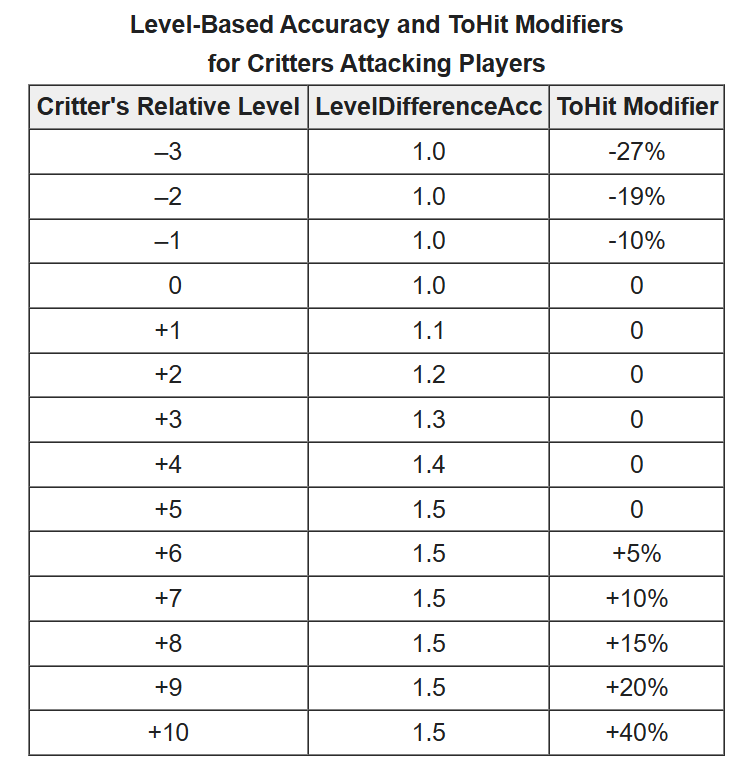
Here's the relevant chart from the Attack Mechanics page in the wiki. Notice that at +5 the ToHit modifier is the same as at +4. Only when the mob is SIX levels higher than you plus your level shifts, does it get more ToHit and thus raise the Soft-Cap for you. From even level up to +5, it is getting some incremental accuracy, but not to hit. It will be very slightly more able to hit you and do a little more damage when it does, but those will be hard to notice, unlike a higher softcap. If a player were just barely softcapped at +45% defense, and then suddenly all the mobs got 5% more ToHit, they'd be (roughly) hitting you twice as often -- hitting you 10% of the time instead of 5% of the time. Not a big deal against one opponent, maybe, but if you are surrounded then having the incoming DPS, controls, and debuffs that land double up might hurt a bit more.

-
I suspect the key issue for people is understanding that the mission difficulty label (+4, +5, +6, +7) is not often the level difference they will face. A level 50 with an alpha slot shift in a mission set to difficulty +5 is still going to be facing +4 enemies -- a level 55 boss being fought by a 50+1 player is only +4 to him. Looking at the table "Level-Based Accuracy and ToHit Modifiers for Critters Attacking Players" on the https://homecoming.wiki/wiki/Attack_Mechanics page, we can see that the 45% defense softcap still applies right up to level differences of five. A level 50 player is still going to have a proper 45% softcap vs a a level 55 boss. It's the players who were Sidekicked to level 49 who'll see softcap trouble in the +5 content. If gets more interesting in incarnate content. +7 difficulty that produces level 57 and level 58 enemy mobs will still be at the same incarnate softcap (59% iirc?) to 50+3 players. The level 58 enemies are still only 5 levels higher than a combat level 53 player. But to a level 50 player without all three combat shifts from incarnate slots, or especially to sidekicked level 49 players, those level 58's are going to hurt. As they should. ^_^ If I've done the addition right, the level 49's are going to be up against a 79% softcap -- if everyone has maneuvers running or good team buffs, it'll work out. If not, hope your character has good medical insurance.